
EN
Hydrogels are essential soft materials in biomedicine, environmental science, and tissue engineering, where precise tuning of the elastic modulus (G') is vital for tissue compatibility and cell fate regulation. While high-pressure processing conventionally strengthens hydrogels through enhanced crosslinking and network densification, a team led by Prof. Lei Su, Katsuyoshi Nishinari, and Ho-Kwang Mao reports that locust bean gum (LBG) hydrogels paradoxically undergo progressive softening under high pressure. This finding, published in PNAS, fundamentally challenges the prevailing paradigm of pressure-induced gel reinforcement.
Conventional hydrogel modification strategies, including freeze-thaw cycling, nanocomposite incorporation, and so on, primarily aim to enhance stiffness and toughness. Among these, alternating freeze-thaw (AFT) processing has long served as a benchmark method for modulating mechanical properties via cryo-induced phase separation and hydrogen bond reorganization. Recently, modulation using pressure has been extended to hydrogels, with alternating compression-decompression (ACD) shown to rapidly augment the mechanical performance of polyvinyl alcohol (PVA) and hyaluronic acid hydrogels through mechanisms functionally analogous to AFT. However, the generality of pressure-induced stiffening across diverse biopolymeric gel systems remains underexplored, and the mechanisms at the molecular scale governing such responses are still insufficiently elucidated.
Employing precision pressure-loading devices including diamond anvil cells (DAC) and a piston cylinder apparatus, the research team systematically investigated the mechanical and microstructural evolution of locust bean gum (LBG) hydrogels subjected to alternating compression-decompression (ACD) treatment at pressures up to 1.2 GPa. They compared the effects of ACD treatment with the conventional AFT method, integrating rheological analysis, scanning electron microscopy, Fourier-transform infrared spectroscopy, and differential scanning calorimetry to comprehensively characterize structural reorganization and property changes.
The experimental results revealed a dramatic and unexpected softening effect: following ACD cycles, the elastic modulus of LBG hydrogels decreased to approximately 30% of its initial value, with each cycle producing diminishing yet cumulative softening increments. In stark contrast, AFT cycles under identical starting conditions enhanced the modulus by approximately 2.3fold, consistent with conventional expectations. Scanning electron microscopy observations confirmed that this softening corresponds to a structural transition from a porous network morphology to a flocculent, disordered structure, opposite to the pore refinement and densification observed in AFT-treated gels.
Mechanistic investigations elucidated the molecular origin of this anomalous behavior. FT-IR analysis indicated that pressure treatment increases the proportion of free -OH groups while decreasing hydrogen-bonded -OH, suggesting that pressure disrupts rather than strengthens hydrogen bonding in LBG gels. Differential scanning calorimetry further revealed that pressure converts bound water to free water, thinning hydration layer and reducing polymer-polymer interactions. This behavior stands in direct contrast to that observed in PVA hydrogels, where both AFT and ACD treatments increase modulus through crystallization and crosslink reinforcement.
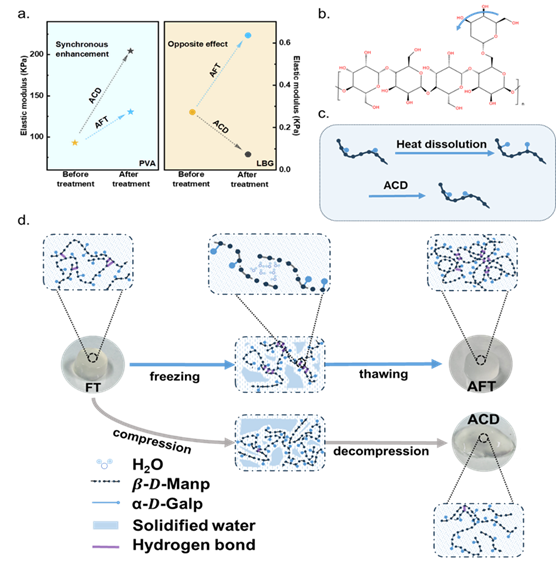
Caption: Schematic diagram of state change of LBG molecular chain and state transition of water and hydrogen bonds during sample treatment by ACD and AFT methods.
The research team attributes this unique pressure response to the distinctive molecular architecture of LBG. LBG is a galactomannan polymer consisting of a mannose backbone with linked galactose side chains. Gel formation relies on six consecutive unbranched mannose segments serving as crosslinking sites. Under pressure, the densely distributed galactose side chains create significant steric hindrance, enhancing galactose-mannose interactions that prematurely block hydrogen bonding sites on the mannose backbone. Unlike PVA, which crystallizes under pressure to prevent chain slippage, LBG molecules remain stretched and non-crystalline, rendering crosslinking points vulnerable to stress concentration and network disruption under compression. Above a critical pressure of approximately 1 GPa, extensive hydrogen bond destruction transforms the gel into a viscoelastic fluid exhibiting shear-thinning behavior.
This counterintuitive softening phenomenon in LBG demonstrates that the effects of pressure on hydrogels are highly dependent on molecular structure, thereby expanding the dimensionality of hydrogel property engineering. Beyond its fundamental significance, the pressure-induced softening offers practical advantages for biomedical applications. The enlarged and interconnected pore architecture induced by ACD treatment promotes efficient nutrient diffusion and robust cell infiltration, and its reduced crosslinking density more faithfully recapitulates the mechanical microenvironment of native soft tissues. This unique combination of structural features complements the denser, stronger networks typically generated through freeze-thaw processing. Collectively, AFT and ACD provide complementary tools for precisely tuning hydrogel properties across a broad modulus range, from stiff scaffolds for bone regeneration to soft matrices for neural tissue engineering.
This work establishes pressure modulation as a versatile strategy for hydrogel modification, demonstrating that high pressure can either strengthen or soften gels depending on their molecular architecture. The findings provide a novel paradigm for designing tunable biomaterials with precisely controlled mechanical and structural properties.
水凝胶是一种非常重要的软物质材料,其力学性能的精准调控对实现组织相容性匹配至关重要。传统观点认为高压处理通过促进交联增强水凝胶强度。北京高压科学研究中心(HPSTAR)苏磊研究员,与西成胜好教授、毛河光院士团队最新研究发现了一个反直觉现象:刺槐豆胶(LBG)水凝胶在高压下不仅没有变硬,反而发生渐进式软化,弹性模量降至初始值的30%左右,与冷冻解冻法增强 2.3 倍的效果截然相反。研究揭示:这一反常行为源于 LBG 独特的半乳甘露聚糖分子结构 —— 高压下半乳糖侧链的空间位阻效应破坏而非增强了氢键,导致网络结构坍塌。该发现挑战了压力增强凝胶的传统范式,为水凝胶性能调控提供了全新维度,相关成果发表于Proceedings of the National Academy of Sciences(PNAS)。


自由 Freedom
合作 Collaboration
顶尖 Excellence