
EN
High-temperature, robust superconductors are key to unlocking the door to “zero-loss power transmission.” Recently, New research from a team of scientists led by Dr. Wenge Yang of the Center for High Pressure Science and Technology Advanced Research (HPSTAR), achieved a record-high robust superconducting temperature of 32 K in the transition metal diboride MoB₂ among known conventional superconducting systems. The results were published in Materials Today.
Superconducting materials exhibit zero electrical resistance below a certain temperature, allowing current to flow without any loss. However, this usually requires extremely low temperatures, consuming significant energy. Therefore, scientists have been searching for superconductors with high transition temperatures that remain robust under varying external conditions. Over the past decade, superconducting transition temperatures under high pressure have continued to break records. However, Tc typically fluctuates significantly with pressure, making it a central challenge in condensed matter physics to maintain robust superconductivity under extreme high-pressure conditions. Previously, systems such as NbTi, high-entropy alloys, and Ti exhibited some degree of robust superconductivity, but their robust Tc rarely exceeded 20 K.
This team has, for the first time, achieved robust superconductivity as high as 32 K in the transition metal diboride MoB₂. Using diamond anvil cell techniques, combined with high-pressure electrical transport measurements and synchrotron in-situ X-ray diffraction (XRD) experiments, the team systematically studied the superconductivity of MoB₂ under ultrahigh pressures. Experimental results show that MoB₂ exhibits an 18.5 K superconducting transition at ~48 GPa, after which Tc rapidly increases with pressure, reaching 32 K at ~105 GPa. Remarkably, even when the pressure is further increased to ~230 GPa, Tc remains nearly unchanged at 32 K, demonstrating exceptional “pressure robustness.” Meanwhile, the material exhibits typical diamagnetic behavior, further confirming the authenticity of the superconducting state.
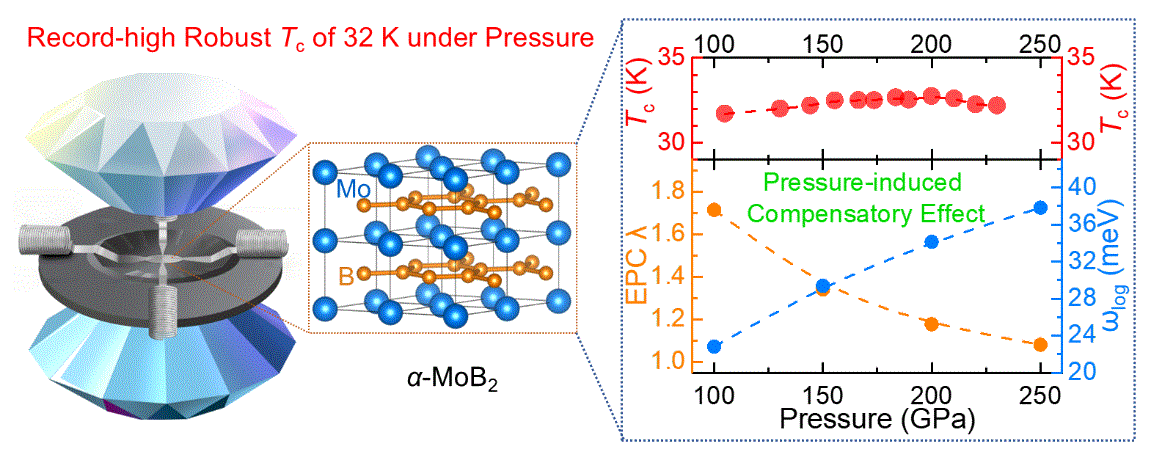
Synchrotron XRD results reveal that this excellent robust superconductivity is closely related to a high-pressure-induced structural phase transition. Under high pressure, MoB₂ undergoes a transition from the β phase to the α phase, with the transition largely complete around 135 GPa. Once the system fully transforms into a pure α-MoB₂ phase, Tc enters a stable plateau region, indicating that the α phase is the key structural foundation supporting high Tc and robust superconductivity.
To understand the physical mechanism behind this robustness, the team conducted first-principles calculations of the electronic structure and electron-phonon coupling (EPC). The results indicate that under high pressure, lattice compression reduces the electronic density of states and weakens the electron-phonon coupling constant λ, which would normally lower Tc . However, high pressure also significantly increases the average phonon frequency ωlog, enhancing superconducting pairing. These two opposing effects form a fine “compensation” in α-MoB₂, ultimately keeping Tc robust over a wide pressure range. This “compensation mechanism” is entirely different from previous robust superconductors, which rely on strong electron-phonon coupling alone, representing a new high-pressure mechanism for robust superconductivity.
Further analysis shows that Mo’s 4d electrons play a central role in superconductivity, particularly the strong hybridization between dz² orbitals of Mo and B-2pz orbitals, which is an important source of strong electron-phonon coupling. This is distinctly different from classical superconductors like MgB₂, where superconductivity is dominated by σ-bond electrons in the boron layers, suggesting that d-electron-dominated layered diboride systems may be an important direction for discovering high- Tc robust superconductors in the future.
This work not only sets a new record for robust superconducting transition temperature among conventional superconductors but also provides new insights into superconducting pairing mechanisms and electron-phonon interactions under extreme high-pressure conditions, opening a new research direction for exploring superconducting materials with both high Tc and robustness.
高温、高稳健的超导体,是人类叩开“零损耗输电”大门的关键。北京高压科学研究中心(HPSTAR)杨文革研究员课题组联合上海科技大学、中国人民大学等单位,在高压超导研究领域取得重要进展。研究团队在过渡金属二硼化物MoB2中实现了32 K的稳健超导性,其在~105–230 GPa的超宽压力区间内保持几乎恒定的超导转变温度,打破了目前已知的传统超导体系中最高“稳健”超导温度(Robust Tc)的新纪录。相关成果以“The record-high robust superconducting temperature of 32 K in α-MoB2 under high pressure”为题发表于《Materials Today》。


自由 Freedom
合作 Collaboration
顶尖 Excellence