
EN
In common refrigeration methods, the use of fluorocarbon refrigerants may lead to severe environmental problems, while solid-state phase transitions are constrained by indirect heat transfer and interface thermal resistance, requiring the use of secondary heat transfer fluids. To address these challenges, a team of researchers, co-led by Dr. Kuo Li from the Center for High Pressure Science and Technology Research, has proposed an innovative refrigeration concept — the barocaloric effect at dissolution (BCE at dissolution). This study introduces the idea of using pressure to control the dissolution-crystallization process of solid-state refrigerants, where the solution acts both as the refrigerant and the heat transfer fluid. This breakthrough achieves the simultaneous realization of three core advantages: large cooling capacity, low carbon emissions, and efficient heat transfer, opening up a feasible technical pathway for the development of sustainable next-generation refrigeration systems. The related findings were published in Nature under the title "Extreme barocaloric effect at dissolution."
High-pressure dissolution-crystallization phase transition is the fundamental physical-chemical process in the barocaloric effect at dissolution. Compared to commonly discussed temperature-dependent phase diagrams in physical chemistry, people are less familiar with high-pressure phase transitions and even more so with high-pressure relations in multicomponent systems. A common question is whether high pressure promotes dissolution or precipitation. In fact, high-pressure relations share certain similarities with temperature-dependent relations, as both are based on thermodynamic principles, and accurate judgment must be based on strict thermodynamic calculations. Here, we provide a semi-quantitative interpretation using the NH4SCN -H2O solution system from the paper (Figure 1(b)): at normal pressure, at the left endpoint of the phase diagram, water solidifies into ice (Ih phase) as the temperature decreases to zero. At the right endpoint NH4SCN is in the solid phase (monoclinic phase). At room temperature, the saturated solution (Point A, ~63 wt%) precipitates NH4SCN as the temperature decreases, and the solution composition shifts along the liquid phase line until the eutectic point (Point B, ~50 wt%), where NH4SCN and ice both precipitate. No compound of NH4SCN and water was observed in this solution system; This phase diagram is a simple binary eutectic phase diagram.
When pressure is applied at room temperature, the relationship becomes slightly more complex, but it remains a binary eutectic phase diagram. Water solidifies into ice-VI at 1 GPa, and at 2 GPa it forms ice-VII. NH4SCN solid undergoes a transition from the monoclinic phase to the orthorhombic phase. Notably, the orthorhombic phase is a high-temperature phase but has a smaller volume than the monoclinic phase and is also a high-pressure phase. When a concentrated NH4SCN solution is pressurized to drive the precipitation of solid NH4SCN, the orthorhombic phase is the stable phase.
Through Raman spectroscopy and optical observation, the study found that at room temperature, when the concentration of NH4SCN in the aqueous solution exceeds ~35 wt%, the pressure for precipitating NH4SCN crystals decreases with increasing concentration. When the concentration is below ~35 wt%, ice precipitates first, and as the concentration decreases, the precipitation pressure also drops. This exhibits characteristics of a binary eutectic phase diagram, except that the eutectic point is not the “low eutectic point” seen in normal temperature-dependent phase diagrams, but the “high eutectic point” at room temperature and high pressure. Since viscosity increases under high pressure, crystallization is delayed, and the “overpressure” of ice precipitation leads to a local concentration spike, which also results in NH4SCN precipitation. This is a key difference from the normal temperature-dependent behavior.
By comparing the phase diagram of NH4SCN aqueous solution at high pressure and room temperature with that of temperature-dependent phase diagrams at normal pressure, we observe that due to the influence of high pressure (including a series of phase transitions), the eutectic point concentration can be as low as ~35 wt%, which is significantly lower than the concentration of ~50 wt% required to reach the eutectic point through temperature adjustment. This difference indicates that high pressure enables more NH4SCN to precipitate, which in turn allows for greater heat absorption during the dissolution process. This is a key basis for the barocaloric effect dissolution to provide high cooling capacity and high thermodynamic second-law efficiency.
Due to the complexity of phase transitions under high pressure, especially the water-ice phase transitions, a more in-depth study is required to fully and accurately understand the high-pressure crystallization relations of the solution. However, this also provides a vast space for further regulating the related systems, discovering new phenomena, and developing new functions.
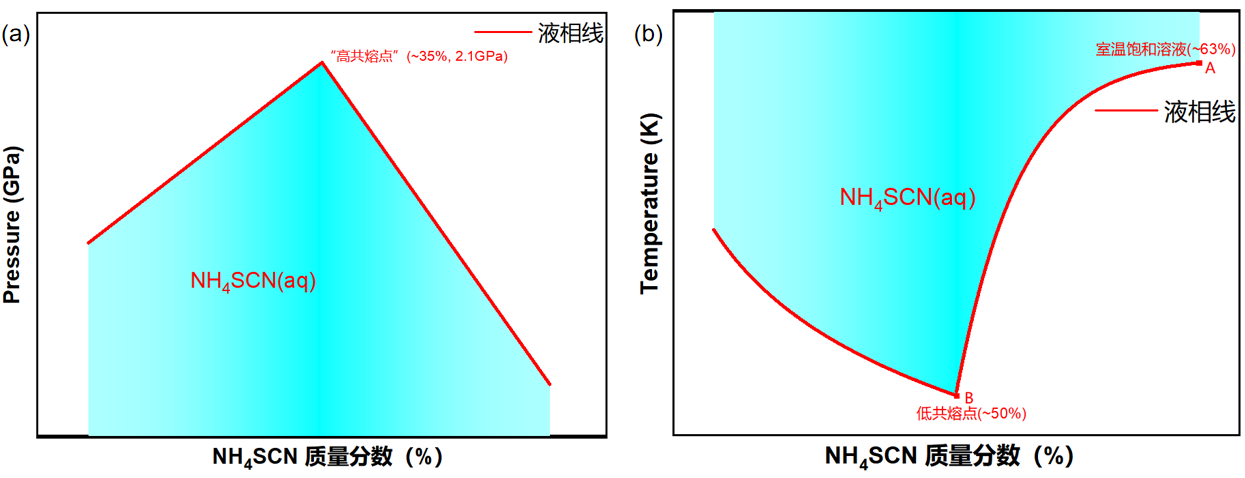
Caption: (a) The phase diagram of NH4SCN aqueous solution at room temperature and high pressure; (b) The phase diagram of NH4SCN aqueous solution at different temperature and ambient pressure
在常见的制冷方式中,使用氟碳制冷剂可能引发严重环境问题,而固态相变受制于间接传热和界面热阻的限制,需要使用二次传热流体。近日,中国科学院金属研究所、北京高压科学研究中心等多个单位合作,提出并实验证实了一种新型制冷概念——溶解压卡效应。该研究工作提出利用压力来调控固态冷媒的溶解-析晶过程,溶液既是制冷介质,又是传热流体,突破性地实现了三大核心优势的同步达成:大制冷量、低碳排放和高效传热,为构建可持续发展的下一代制冷体系开辟了切实可行的技术路径。相关研究结果以“Extreme barocaloric effect at dissolution”为题发表于Nature。


自由 Freedom
合作 Collaboration
顶尖 Excellence