
EN
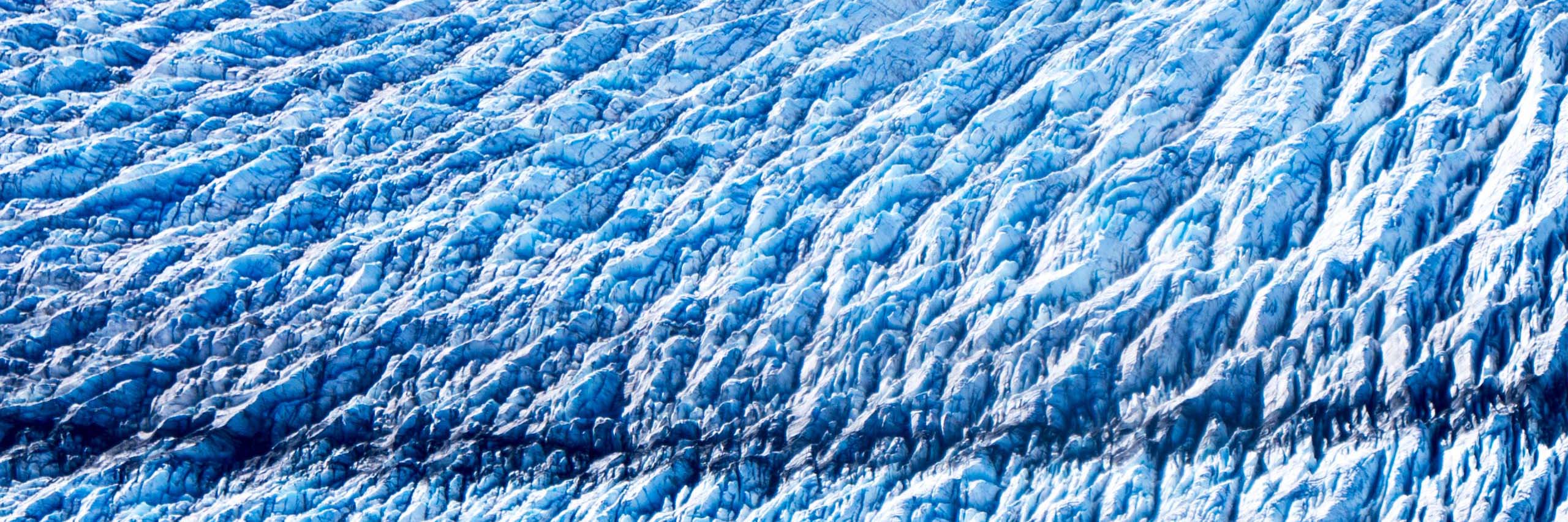
 | An experimental study on apparent activation energyNSFC 42572252Existing rheological models exhibit significant discrepancies in the variation of apparent activation energy with temperature near the melting point, and the underlying physical mechanisms remain unclear. These discrepancies limit the accurate modeling of glacial dynamics and the evolution of icy planetary bodies. This project focuses on the rheological behavior of ice near its melting point, aiming to fill the gap in high-precision rheological data for this critical temperature range through systematic plastic deformation experiments. This work will also lay the foundation for understanding the impact of premelting on the rheological properties of ice. The outcomes of this research will provide essential support for the theoretical development of glaciology, planetary science, and related fields. Left: from Fan et al. (2025). | |
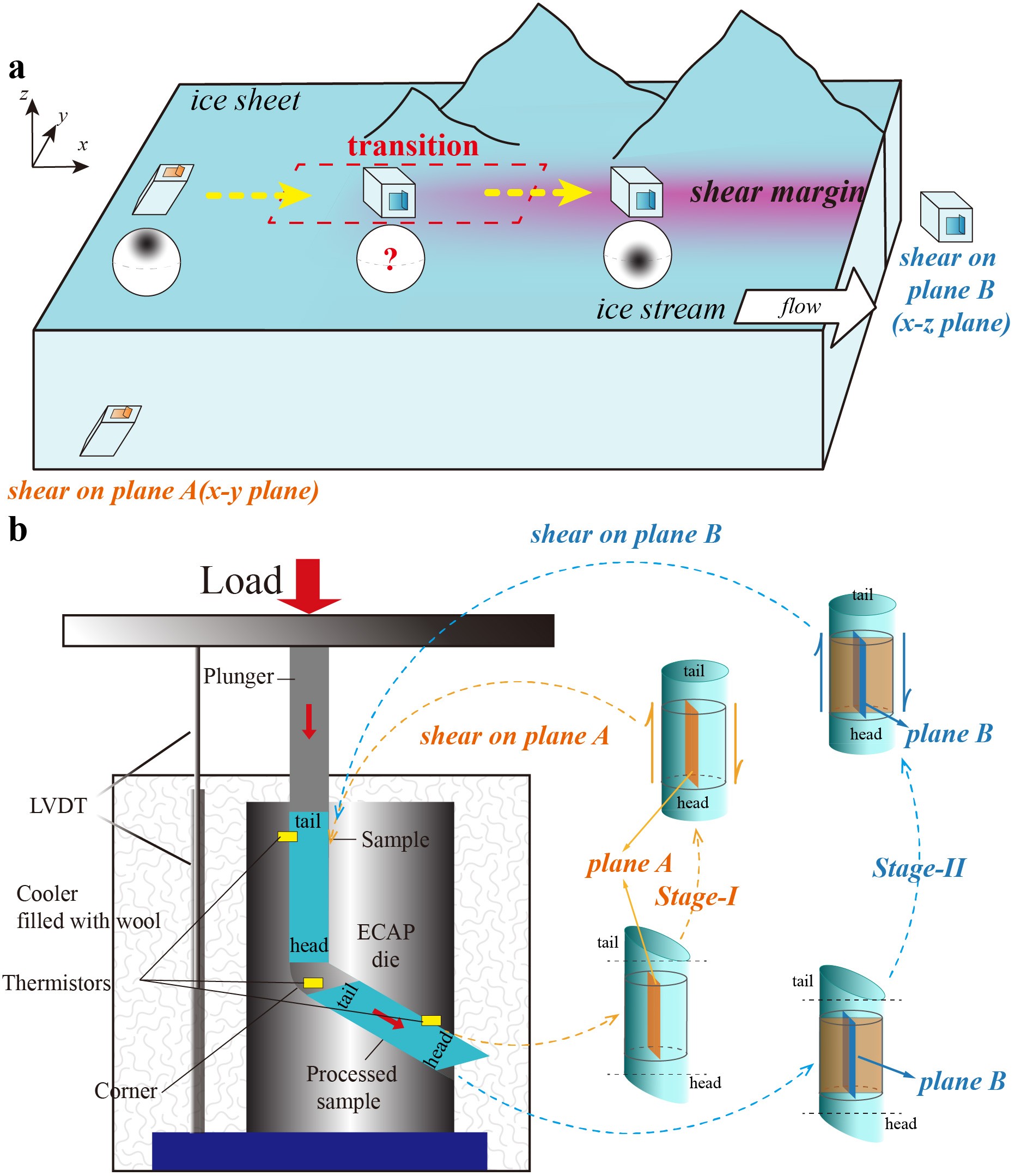 | Microstructural evolution of CPOs in changing deformation kinematicsafter finish NSFC 41972232When deep ice-sheet ice (below ~200 m), typically possessing a preexisting CPO, enters the shear margin, a change in deformation kinematics occurs: the shear plane transitions from horizontal to vertical, while maintaining the shear direction. This kinematic adjustment induces a CPO transition. Experimental studies confirm that the internal plastic deformation of ice is governed by CPOs, because the formation of CPOs imparts strong mechanical anisotropy to ice bodies. Thus, this CPO transition, in turn, modulates the ice flow dynamics and, consequently, the rate of oceanward discharge. To investigate the CPO transition occurred when ice enters the shear margin, we simulate the change in deformation kinematics in laboratory experiments by a two-stage deformation. Synthetic polycrystalline ice, doped with a very small fraction of graphite, samples were deformed at -5°C using an equal-channel angular pressing (ECAP) apparatus. Left: unpublished | |
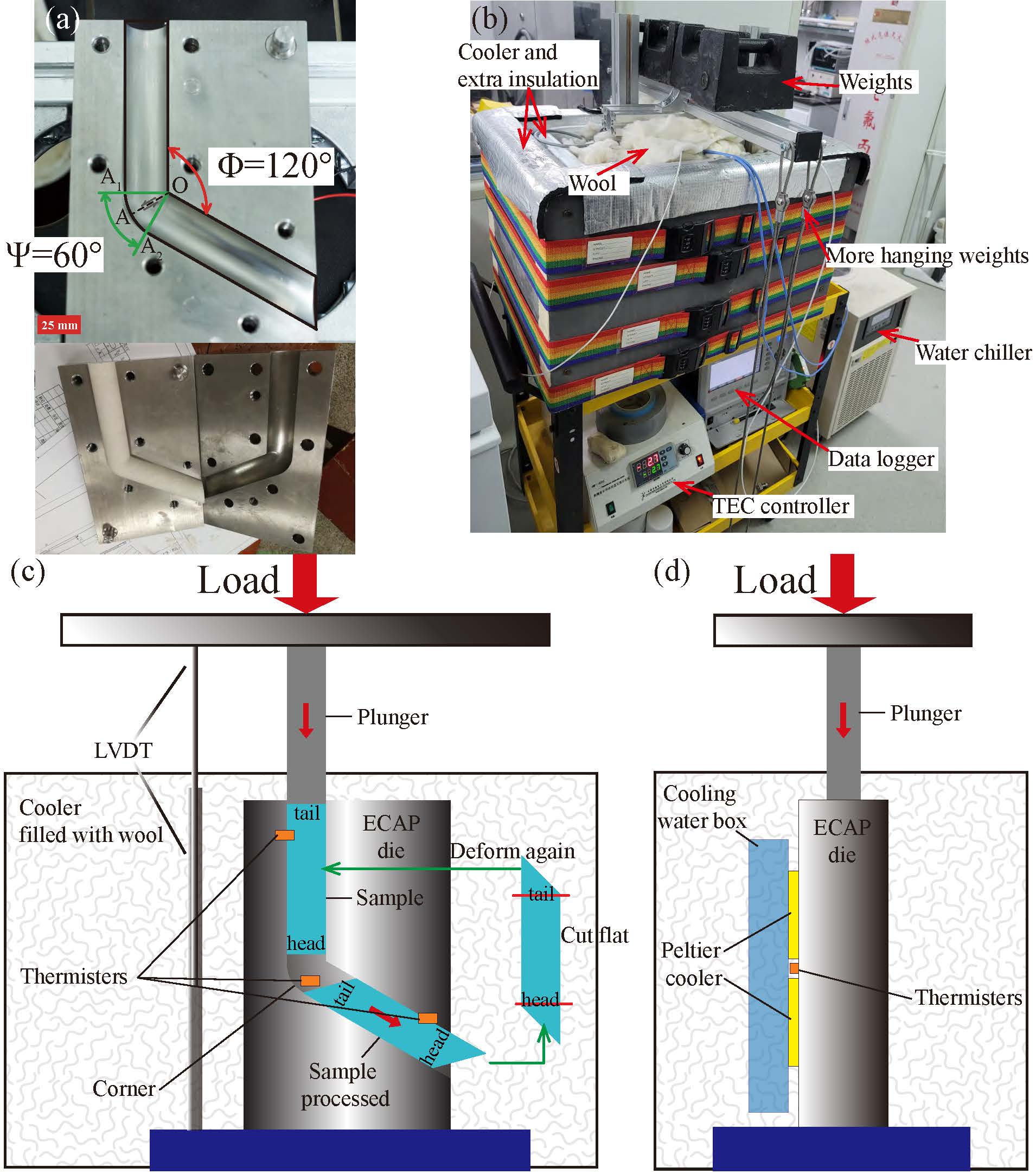 | Microstructural evolution of CPOs in highly deformed iceNSFC 41972232During plastic deformation of polycrystalline ice 1h, crystallographic lattice of ice become preferentially aligned due to dislocation glide. Such crystallographic preferred orientation (CPO) introduces a viscous anisotropy in ice, and thus strongly influences the flow of glaciers and ice sheets on Earth and the convection in the icy crust of icy astronomical bodies. The maximum strains achieved in laboratory experiments are limited, such that the evolution of CPOs in ice deformed to strains comparable to those in natural ice bodies has never been investigated. Utilizing a new experimental method --- equal-channel angular pressing, this project aims to extend the range of strains achieved in laboratory experiments to that of naturally deformed ice, and study the formation and evolution of CPOs in ice at such large strains. Nominal shear strains of up to 6.2, equivalent to a nominal von Mises strain of 3.6, were achieved in samples at a temperature of -5°C. Cryo-electron backscatter diffraction analysis reveals a primary cluster of crystal c axes perpendicular to the shear plane in all samples, accompanied by a secondary cluster of c axes at an oblique angle to the primary cluster antithetic to the shear direction. A synthesis of various experimental data suggests that the CPO pattern, including the orientation of the secondary cluster, results from a balance of two competing mechanisms: lattice rotation due to dislocation slip, which fortifies the primary cluster while rotating and weakening the secondary one, and grain growth by strain-induced GBM, which reinforces both clusters while rotating the secondary cluster in the opposite direction. As strain increases, GBM contributes progressively less. This investigation supports the previous hypothesis that a single cluster of c axes could be generated in high-strain experiments while further refining our comprehension of CPO development in ice. Left: from Wang et al. (2025). |


自由 Freedom
合作 Collaboration
顶尖 Excellence