
EN
Mars is thought to have experienced a global magma ocean during its earliest evolution. The cooling and crystallization of this primordial magma ocean played a fundamental role in shaping the planet’s first crust and mantle. However, how the Martian magma ocean crystallized under the conditions of the early planet, and what type of primitive crust it produced, have remained important open questions. A new study led by Dr. Yanhao Lin at the Center for High Pressure Science and Technology Advanced Research (HPSTAR), published in Science Advances, provides new experimental constraints on the early differentiation of Mars. Using updated estimates of the Martian interior, the researchers reconstructed the crystallization sequence of the magma ocean and revealed the formation of a plagioclase- and silica-rich protocrust, as well as a previously unrecognized density structure in the early mantle.
Previous models generally assumed a relatively iron-rich Martian mantle containing approximately 17–19 wt.% FeO and a core–mantle boundary (CMB) at depths of up to about 2,000 km. Recent seismic observations from NASA’s InSight mission instead place the CMB at approximately 1,520–1,600 km depth, corresponding to about 18.5 GPa, while the mantle FeO content has been estimated at approximately 13.7 wt.%.
These updated constraints can substantially change the minerals that crystallize from the magma ocean and the density structure of the resulting mantle.
The researchers experimentally simulated magma-ocean crystallization under the updated conditions using multi-anvil, cubic-anvil, and piston-cylinder presses, together with a box furnace. The experiments covered pressure–temperature conditions from the deep Martian mantle to near-surface environments, with oxygen fugacity controlled within the range estimated for the Martian interior.
The experiments indicate that wadsleyite crystallized in the deep interior during the early stages, while olivine formed at shallower depths together with pyroxene, majoritic garnet, and spinel. With progressive crystallization, olivine gradually disappeared, while clinopyroxene, orthopyroxene, and spinel became increasingly dominant.
A key transition occurred during the final stages of solidification. Plagioclase began to crystallize when approximately 95% of the magma ocean had solidified, followed by quartz at around 98% solidification.
The nature of the earliest Martian crust has long been debated. Although Mars is traditionally considered to have a predominantly basaltic crust, seismic observations, spectral data, rover measurements, and Martian meteorites have revealed evidence for crustal materials enriched in plagioclase and silica.
The new experiments demonstrate that plagioclase and quartz can crystallize directly from the residual magma during the late stages of Martian magma-ocean crystallization. Combining the experimental results with thermodynamic modeling, the researchers estimate that the resulting primitive crust could have reached approximately 32 km in thickness, including ~26 km constrained by experiments through ~99% crystallization and an additional ~6 km estimated for the final 1% using the MAGEMin package.
Because plagioclase is less dense than the underlying magma and mantle materials, the newly formed plagioclase-rich layer could have floated at the surface, forming a differentiated protocrust during the final stages of magma-ocean solidification.
These results suggest that the earliest Martian crust may not have been exclusively basaltic. Instead, a plagioclase- and silica-rich protocrust could have formed directly from the late-stage magma ocean.
Magma-ocean crystallization also determines the density structure of the newly formed mantle. Because minerals crystallizing at different stages have different densities, the resulting cumulate layers can become gravitationally unstable and drive large-scale mantle overturn.
Previous models based on the crystallization sequence proposed by Elkins-Tanton et al. (2005) suggested the formation of a dense garnet-rich layer approximately 150 km thick.
The new experiments indicate a different density structure. Under the updated Martian conditions, a thick, continuous garnet-rich layer does not develop. Instead, iron-rich spinel continues to crystallize during the late stages of magma-ocean solidification, producing dense spinel-bearing cumulates in the shallow mantle, particularly at depths shallower than approximately 170 km.
After complete solidification, these dense shallow cumulates could have become gravitationally unstable and sunk into the deeper mantle, while less dense material from greater depths rose upward. This revised density structure provides new constraints on models of early Martian mantle overturn and the redistribution of chemically distinct mantle reservoirs.
The study provides an experimentally constrained framework for understanding the coupled evolution of the Martian crust and mantle during the planet’s earliest history. The formation of a plagioclase- and silica-rich protocrust offers a possible explanation for the diverse crustal compositions observed on Mars, while the revised mantle density structure provides new constraints on early mantle overturn and the formation of distinct mantle reservoirs recorded by Martian meteorites.
Future studies combining high-pressure experiments with meteorite geochemistry and geophysical observations may further clarify how the magma ocean shaped the early crust and interior of Mars. The results may also provide a reference for interpreting ancient igneous materials that could eventually be returned to Earth by future Mars Sample Return missions.
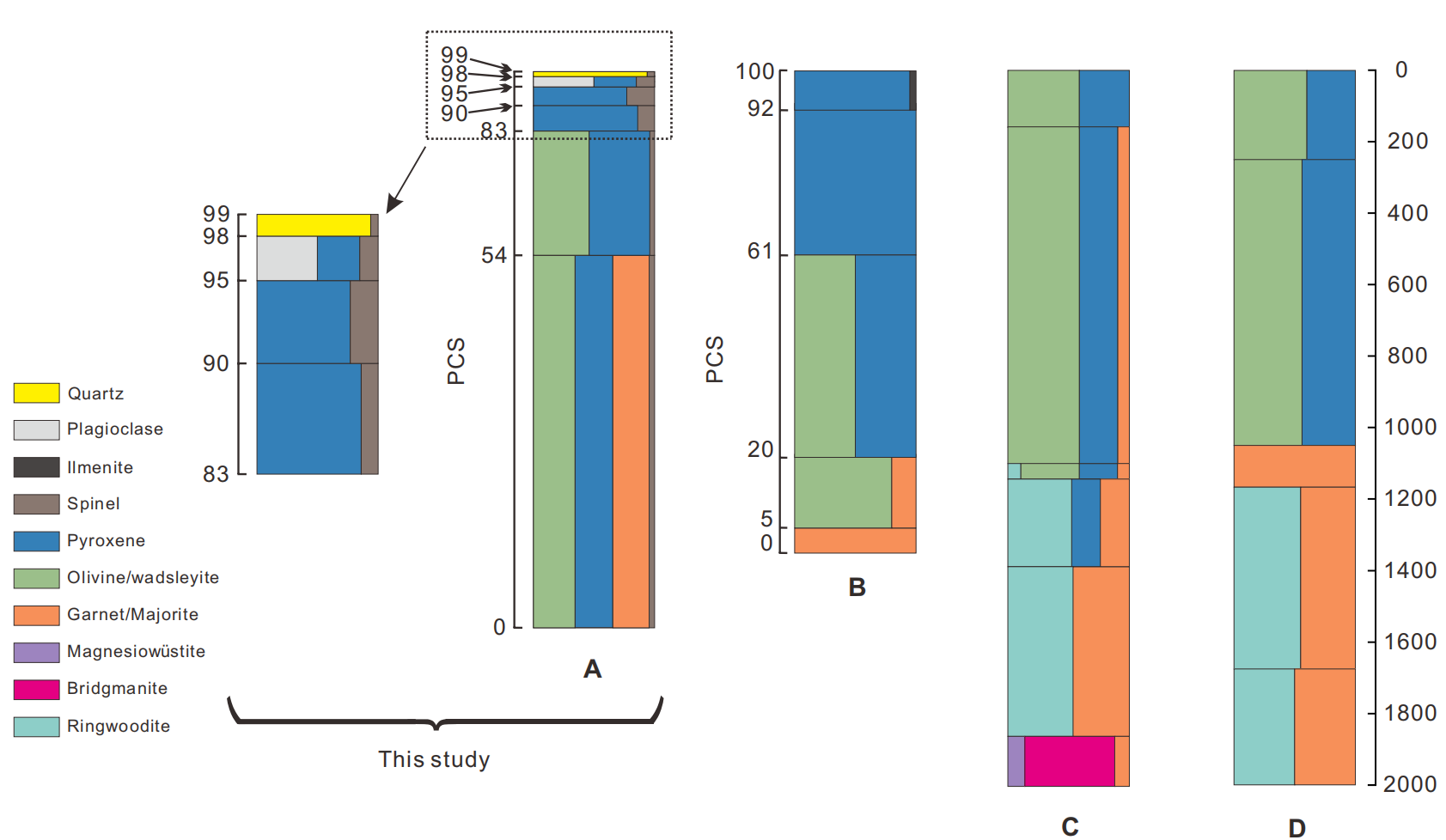
Figure 1. Comparison between the Martian magma-ocean crystallization sequence obtained in this study and previous models. (A) The magma-ocean crystallization sequence obtained in this study; (B) the crystallization-sequence model of Borg and Draper (2003); (C) the Martian mantle mineralogical model of Bertka and Fei (1997); and (D) the crystallization-sequence model of Elkins-Tanton et al. (2005).
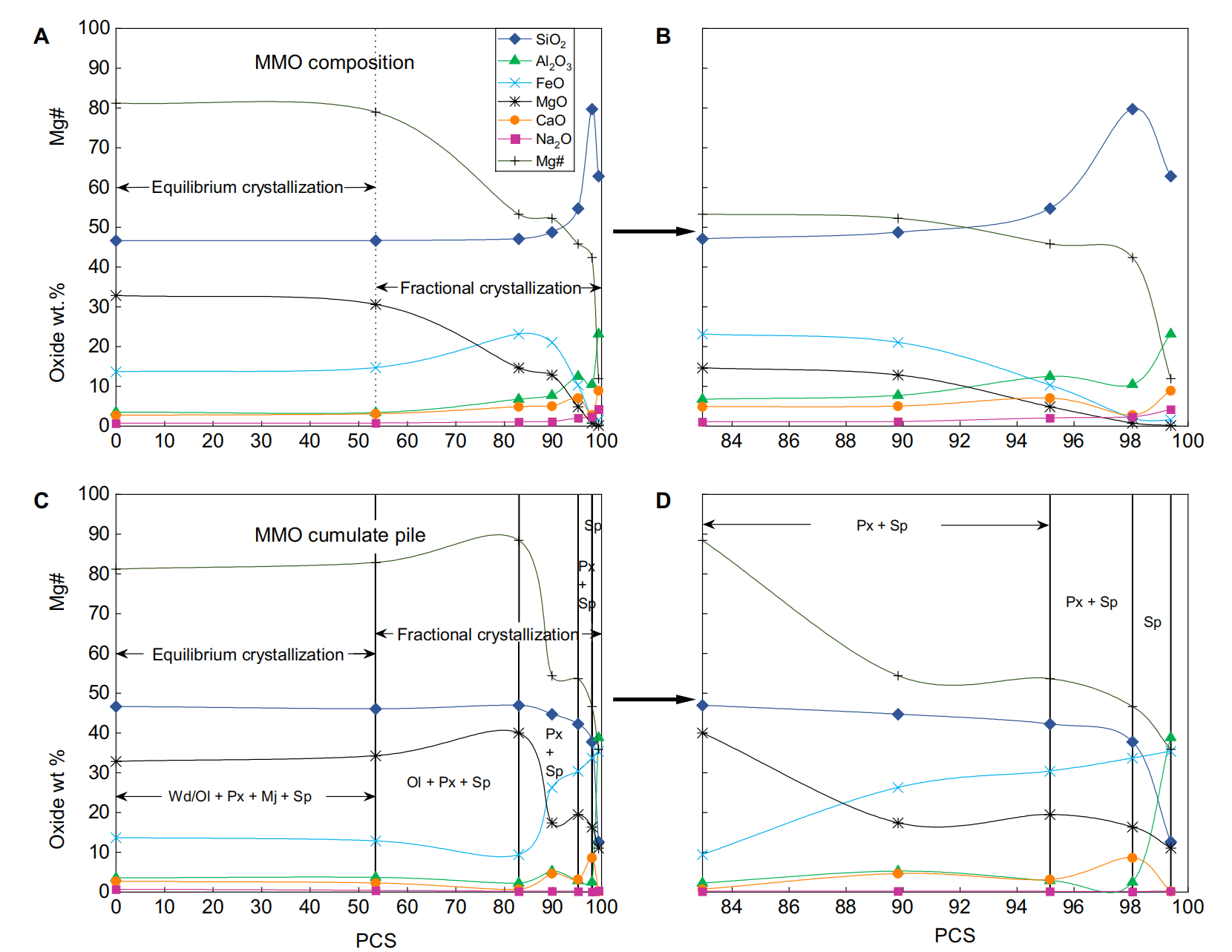 Figure 2. Compositional evolution of the Martian magma ocean and cumulate layers. (A) Chemical compositional evolution of the residual magma ocean during Martian magma-ocean crystallization; (B) enlarged view of the region shown in panel (A); (C) chemical compositional evolution of the cumulate layers, excluding the Martian crust; and (D) enlarged view of the region shown in panel (C).
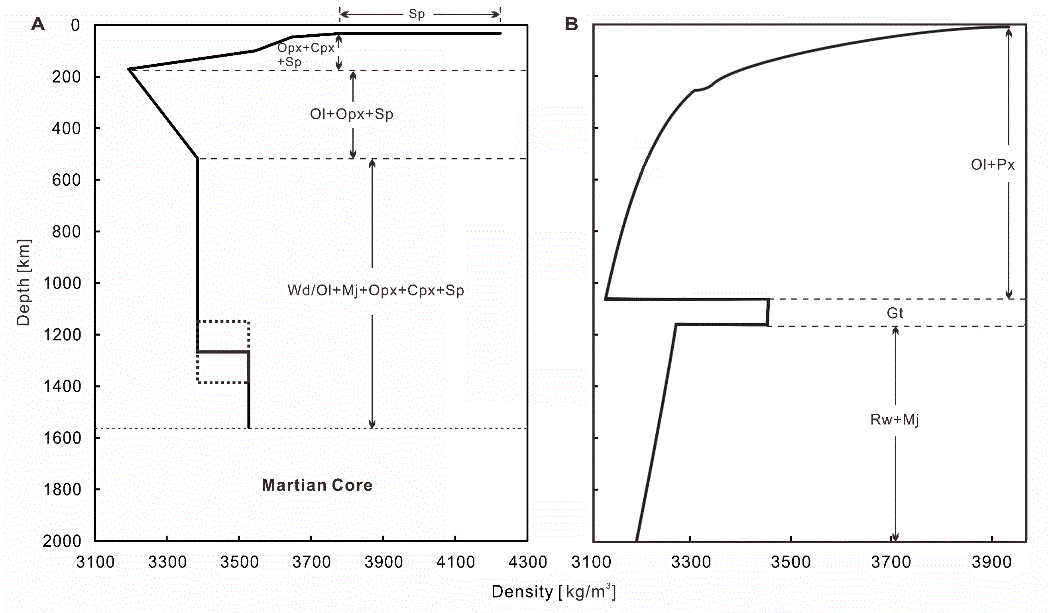
Figure 3. Density profile of the Martian mantle after crystallization. (A) Martian mantle density profile obtained in this study (to ~99 PCS). (B) Martian mantle density profile plotted according to the model of Elkins-Tanton et al. (2005).
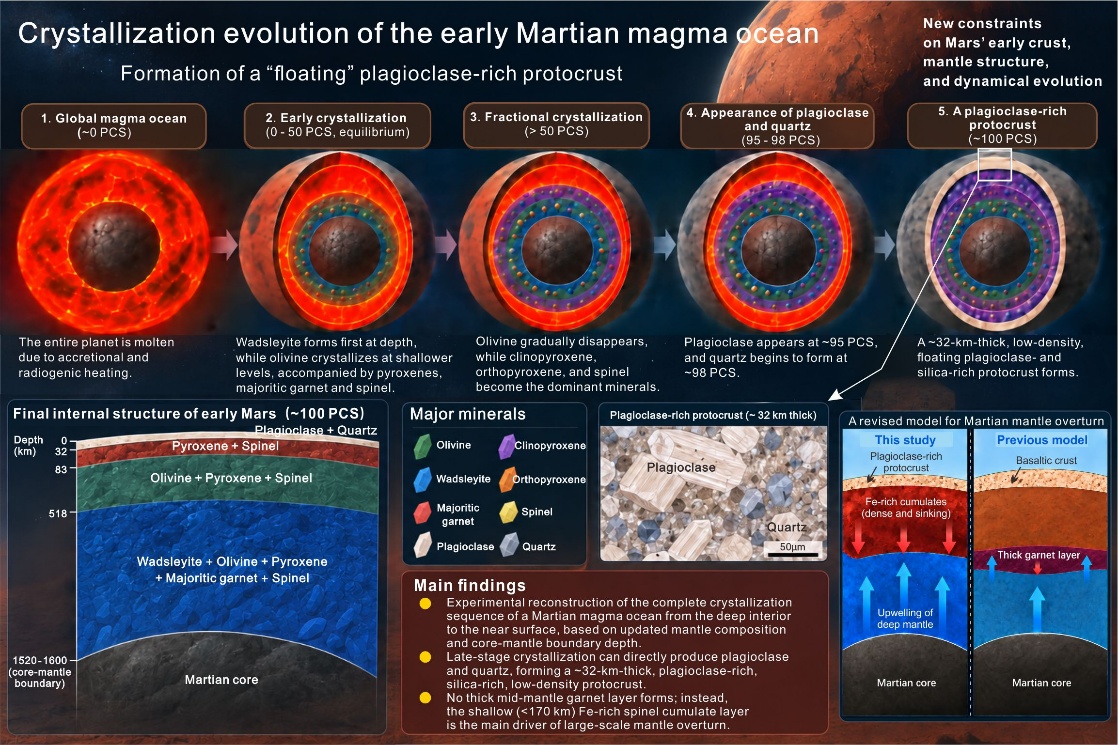
Figure 4. Schematic illustration of early Martian magma ocean crystallization and mantle overturn.
火星演化早期曾存在一个覆盖了整个行星的巨大岩浆洋,而早期岩浆洋的冷却、脱气和结晶过程控制了原始火星壳的形成、大气组成与地幔动力学。近日,北京高压科学研究中心林彦蒿研究员团队,在《Science Advances》发表最新研究成果"A plagioclase-rich protocrust on Mars formed by magma ocean crystallization",基于对火星地幔组成和深度的最新数据,通过高温高压实验,首次建立了整个火星岩浆洋的结晶序列,并揭示了富斜长石的火星原始地壳。本研究结果也重新限定了早期火星地幔的密度结构,为早期火星地幔翻转的方式提供了新的认识和实验数据支撑,并对解释火星陨石中的地球化学特征,以及未来火星样品返回任务所带回火成岩样品的分析,具有重要参考意义。


自由 Freedom
合作 Collaboration
顶尖 Excellence