
EN
Recently, a research team led by Kuo Li at the Center for High Pressure Science and Technology Advanced Research (HPSTAR) developed an innovative high-pressure solid-state topological-polymerization strategy. Using this approach, the team synthesized, for the first time, micrometer-long, atomically ordered, and structurally stable carbon-sheathed copper SMACs, achieved milligram-scale bulk synthesis, and successfully exfoliated and characterized individual chains. The findings were published in the leading international journal Science .
Single-metal-atom chains (SMACs) are ultimate one-dimensional structures composed of linearly arranged metal atoms and represent the thinnest known metallic wires. As ideal model systems for investigating fundamental one-dimensional condensed-matter phenomena, including Peierls instability and the Tomonaga–Luttinger liquid, they also provide a unique materials platform for exploring frontier applications in fields such as nanoelectronics, magnetism,and catalysis. Nevertheless, bare SMACs are prone to structural reconstruction and can generally remain stable only with the support of substrates, grain boundaries, or ligands. Constructing SMACs with atomically precise structures, high thermodynamic stability, large dimensions, and scalable production has therefore long been a major technical challenge in the field.
The research team selected β-copper phthalocyanine (β-CuPc), which features columnar molecular stacking, as the precursor. In this material, the central copper ions are periodically and orderly aligned along the molecular stacking direction and surrounded by unsaturated aromatic rings, providing a natural structural framework for the formation of atomic chains. Under external high pressure, adjacent β-CuPc molecules are progressively compressed, continuously reducing the distance between neighboring central copper atoms. When the intermolecular distance reaches a critical reaction threshold, the peripheral aromatic rings undergo polymerization. The resulting saturated carbon framework forms a dense protective sheath that completely encloses the inner copper atomic chains, effectively “locking in” the ordered arrangement of densely packed metal atoms generated under high-pressure conditions and preserving the chain structure upon returning to ambient pressure (Figure 1).
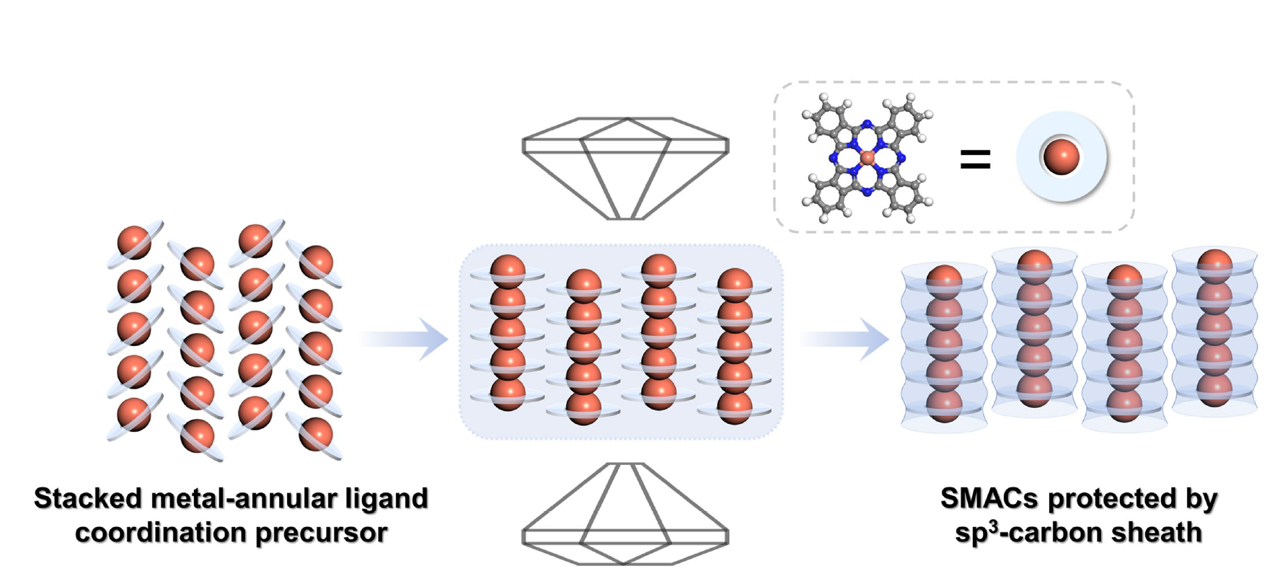 Figure 1. Schematic illustration of the construction of a sSMAC from metal-annular ligand coordination precursors. High-pressure polymerization of organic molecules “locks in” the densely packed metal-chain structure, which persists even after pressure release.
In situ high-pressure experiments reveal that β-CuPc undergoes a structural phase transition at approximately 0.9 GPa. The intermolecular slip angle decreases, leading to a stacking configuration more favorable for topological polymerization. Intermolecular polymerization initiates at 21.5 GPa. After thermal treatment at 533 K for 12 hours under 25.0 GPa, the precursor is fully polymerized, yielding SMACs encapsulated within saturated carbon frameworks. In situ high-pressure single-crystal X-ray diffraction experiments further demonstrate that the lattice parameters estimated from crystal dimensions closely match those determined from diffraction data. This close agreement enables the polymerization process to be directly monitored through changes in crystal dimensions (Figure 2).
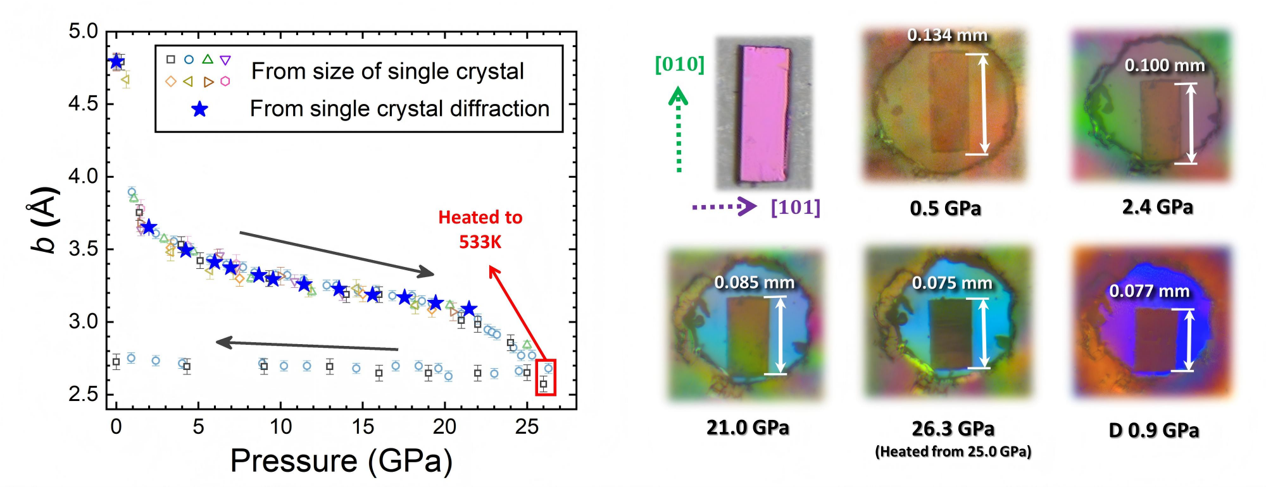
Figure 2. In-situ high-pressure polymerization of β-CuPc single crystals. Lattice parameters calculated from crystal size measurements show excellent consistency with in-situ high-pressure single crystal X-ray diffraction data.
To overcome the limited sample quantities typically produced in diamond-anvil-cell experiments, the team employed a Paris–Edinburgh press to synthesize milligram-scale single crystals of carbon-sheathed copper SMACs at approximately 40 GPa. The as-synthesized crystals reached maximum dimensions of approximately 940 × 250 × 50 μm³. Combined characterization by single-crystal X-ray diffraction, selected-area electron diffraction, and transmission electron microscopy confirmed a high degree of overall structural ordering of the atomic chains. The periodicity along the chains is 2.57 Å, corresponding to the distance between adjacent copper atoms. The weak van der Waals interactions between neighboring chains are insufficient to constrain their relative positions, giving rise to distinctive interchain misalignment within the crystals, as manifested by characteristic “layer-line” patterns in diffraction experiments.
Using an innovative acid-assisted ultrasonic exfoliation strategy, the team successfully isolated intact individual chains from the bulk lattice. Transmission electron microscopy observations revealed that the exfoliated chains can exceed 1 μm in length and contain more than 4,000 sequentially arranged copper atoms—over two orders of magnitude longer than SMACs previously synthesized with organic-ligand assistance. Remarkably, even after hours of ultrasonication and prolonged immersion in trifluoroacetic acid solution, the carbon-sheathed copper atomic chains retained their structural integrity, demonstrating outstanding chemical and mechanical stability conferred by the saturated carbon sheath. Low-dose high-angle annular dark-field scanning transmission electron microscopy (HAADF-STEM) directly resolved a copper–copper spacing of approximately 2.54 Å along individual chains. This value agrees well with the diffraction results and theoretical calculations, further validating the atomically ordered structure of the synthesized SMACs.
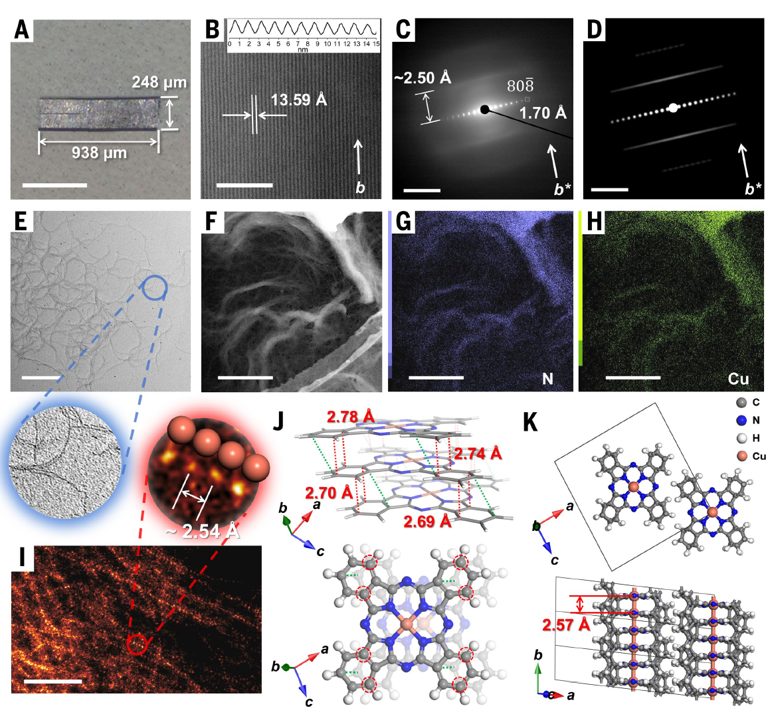
Figure 3. Bulk synthesis and structural characterization of carbon-sheathed copper single-metal atom chains. Near-millimeter-sized single crystals synthesized with a Paris-Edinburgh press, together with STEM imaging and electron diffraction, uncover structural features of the nanowires. Isolated nanowires obtained through acid-assisted exfoliation, with chain-like copper-atom arrangement directly visualized. Scale bars: (A) 500 µm; (B) 20 nm; (C-D) 5 nm-1; (E) 100 nm; (F-H) 200 nm; (I) 5 nm.
Theoretical calculations indicate that, even when compressed to an interatomic distance of 2.57 Å, neighboring copper ions do not form substantial Cu–Cu chemical bonds. Instead, a unique one-dimensional antiferromagnetic chain structure forms within the nanowire core. This behavior is closely related to the intrinsic electronic structure of copper ions, which disfavors metal–metal bond formation. These findings further indicate that the formation of the carbon-sheathed atomic chains is not driven by metal–metal bonding, highlighting the potential generality of this high-pressure synthetic strategy. Axial charge transport within the nanowires is predicted to be mediated primarily by carbon orbitals beneath the outermost shell. The highly compressed structure promotes orbital overlap between the p orbitals of these carbon atoms along the axial direction, thereby generating continuous one-dimensional pathways for charge transport.
Benefiting from the milligram-scale yield and large sample dimensions, the team further experimentally investigated the electrical and magnetic properties of the copper atomic chains. The measurements revealed characteristic one-dimensional antiferromagnetic coupling between closely packed copper atoms. Meanwhile, the atomic chains exhibited pronounced anisotropy in electrical conductivity, with distinct transport behavior parallel and perpendicular to the chain axis. These experimental observations are broadly consistent with the theoretical predictions.
Most importantly, this synthetic strategy is not limited to the copper phthalocyanine system. The research team also conducted high-pressure experiments using cobalt phthalocyanine, nickel phthalocyanine, zinc phthalocyanine, and metal-free phthalocyanine, all of which share similar crystal-stacking characteristics. Following high-pressure treatment, all of these precursors yielded carbon-sheathed one-dimensional polymeric structures with comparable architectures, demonstrating the broad applicability of the high-pressure solid-state topological-polymerization strategy. This approach establishes an experimental foundation for constructing carbon-sheathed single-atom chains with diverse metallic components and opens new possibilities for designing mixed-metal atomic chains and one-dimensional heterostructures.
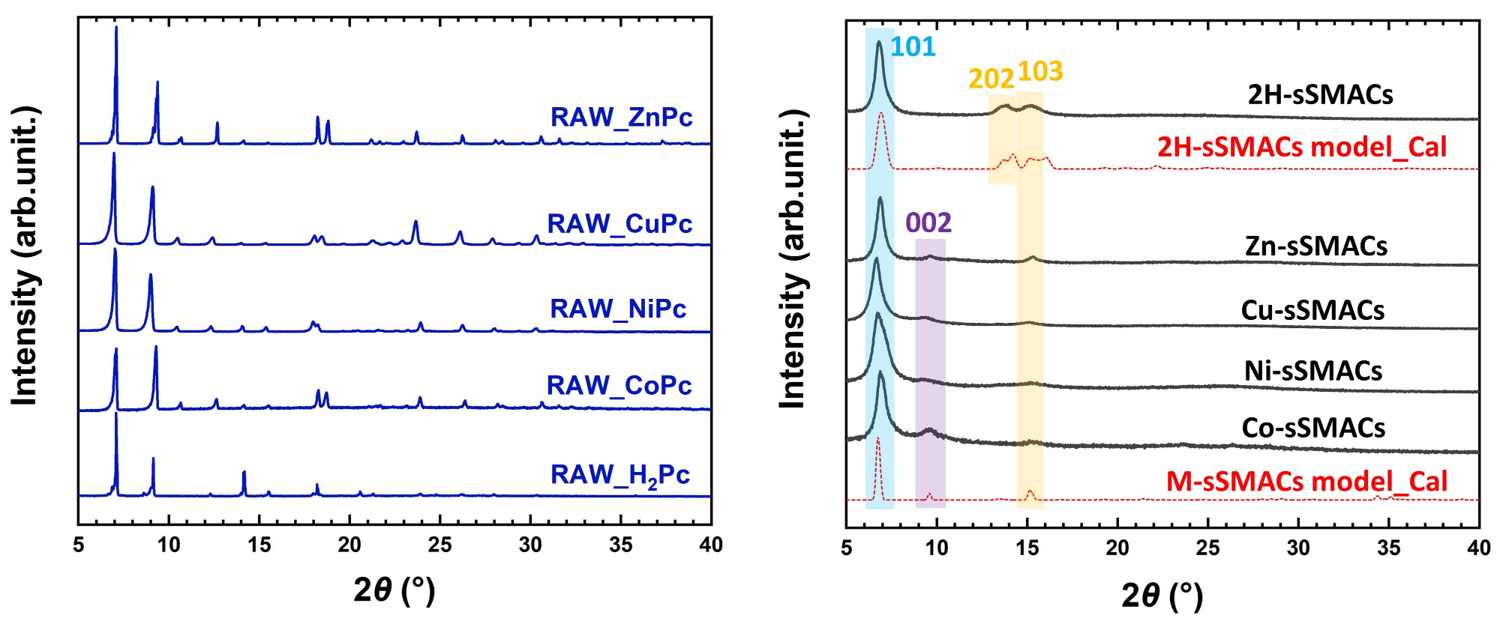 Figure 4. Powder diffraction patterns of SMACs derived from different phthalocyanine precursors. High agreement between experimental and simulated data demonstrates the universality of the high-pressure solid-state topological-polymerization strategy.
单金属原子链是最细的一维金属导线,在低维物理研究、纳米电子、催化等领域极具价值,但裸露原子链易重构,存在链长短、稳定性差、难以批量制备等技术瓶颈。对此,北京高压科学研究中心李阔研究员团队提出一种高压固相拓扑聚合新策略,选取β-酞菁铜作为前驱体,借助高压促使芳香环聚合形成饱和碳鞘,锁定高压下紧密压缩的铜原子链结构,成功实现超长且稳定单金属原子链的宏量合成。所得单链可从晶格剥离并拥有超过以往单金属原子链两个数量级的长度且该方法已被证明是适用于多种金属酞菁体系的普适性策略。相关成果以“Ultralong sheathed single-metal-atom chains synthesized under high pressure”为题发表于Science。


自由 Freedom
合作 Collaboration
顶尖 Excellence