
EN
New research co-led by Dr. Runze Yu from HPSTAR has uncovered the critical role of octahedral connectivity engineering in governing dynamic surface reconstruction and catalytic performance within systems. The results are published in Advanced Functional Materials.
Owing to their structural diversity and tunable electronic configurations, perovskite oxides have long served as a versatile platform for electrocatalyst design. However, their application in alkaline hydrogen evolution reaction (HER) is often hindered by sluggish water dissociation kinetics and suboptimal hydrogen adsorption energetics. A key limitation lies in the intrinsic arrangement of BO6 octahedra, where variations in corner- and face-sharing connectivity significantly influence metal–metal distances, orbital hybridization, and ultimately catalytic activity. Therefore, establishing a direct structure–reconstruction–activity relationship through precise control of octahedral connectivity is essential for advancing high-performance perovskite catalysts. Herein, a connectivity-driven reconstruction strategy is proposed by systematically tuning the ratio of corner-sharing and face-sharing RuO6 octahedra in BaRuO3 polymorphs (3C, 4H, 6H, and 9R). Using high-pressure high-temperature synthesis combined with solid-state methods, a series of structurally distinct models were constructed. Multimodal characterization and in situ Raman spectroscopy reveal that octahedral connectivity dictates reconstruction thermodynamics: excessive corner-sharing promotes rapid amorphization and structural degradation, while dominant face-sharing suppresses reconstruction. Notably, the 6H phase, featuring a balanced connectivity motif, undergoes moderate self-activated reconstruction, forming a stable amorphous RuxOy surface layer while preserving bulk integrity.
This dynamically reconstructed heterostructure induces strong interfacial charge redistribution, enhances Ru 4d–O 2p orbital hybridization, and facilitates interfacial water reorganization. As a result, the energy barrier for water dissociation is significantly reduced, while hydrogen adsorption/desorption energetics approach optimal values. Consequently, the activated 6H-BaRuO3 catalyst delivers exceptional HER performance, achieving an ultralow overpotential of 11 mV at 10 mA cm-2 and a Tafel slope of 27.4 mV dec-1, along with outstanding durability exceeding 150 h at high current densities (200 mA cm-2). This study establishes octahedral-connectivity engineering as a fundamental design principle for regulating dynamic surface reconstruction, providing a robust framework for developing next-generation high-efficiency electrocatalysts for sustainable hydrogen production.
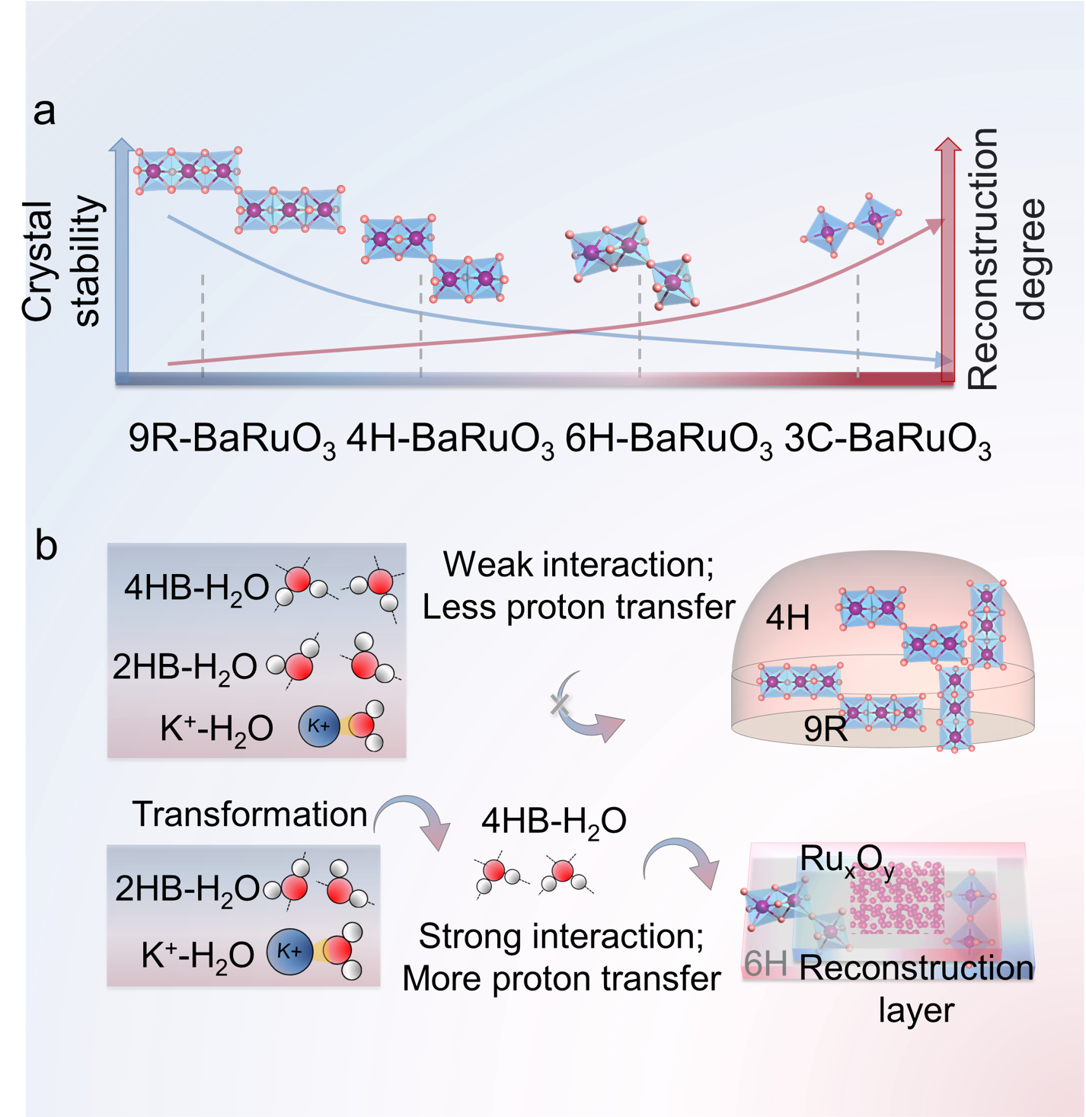
Caption: (a) Schematic diagram linking crystal stability, reconstruction degree, and electrocatalytic activity along the transition from corner- to face-sharing RuO6 frameworks. (b) Schematic illustrations showing the configurations of 4HB-H2O, 2HB-H2O, and K+-H2O.
开发高效且稳定的析氢反应(HER)电催化剂是推动绿色氢能发展的关键科学问题。尽管钌基钙钛矿在碱性条件下具有潜力,但其动态重构机制及结构起源尚不清晰,限制了催化性能提升。近期,北京高压科学研究中心(HPSTAR)于润泽研究员团队在该领域取得重要进展。研究以BaRuO3多型结构为模型,通过调控RuO6八面体由顶点共享到面共享的连接方式,构建了3C、4H、6H和9R等结构体系,系统揭示了八面体连接性对表面重构及催化性能的影响。结果表明,角共享比例增加促进Ba/Ru溶解并加速无定形RuxOy形成,而过多面共享则抑制重构。具有平衡连接特征的6H-BaRuO3可实现适度自激活重构,在保持结构稳定的同时原位生成活性层,诱导界面电荷重分布并优化水解离与氢吸附过程,从而显著提升HER活性与稳定性。6H结构在10 mA cm-2下实现仅11 mV的超低过电位,Tafel斜率低至27.4 mV de-1,并在 1M KOH中200 mA cm-2条件下稳定运行超过150小时。该研究为通过八面体连接工程调控动态重构过程提供了全新视角,为高效电催化材料的理性设计奠定了重要基础。相关结果于近期以“Steering Dynamic Surface Reconstruction via Octahedral Stacking: A Strategy for Highly Efficient Hydrogen Evolution”为题发表于Advanced Functional Materials。


自由 Freedom
合作 Collaboration
顶尖 Excellence